
Meta Title: Hydraulic Oil Cooler Guide: Working Principle, Selection & Maintenance
Meta Description: Learn how hydraulic oil coolers work, how to select the right cooler, proper installation methods, and essential maintenance tips.
URL Slug: hydraulic-oil-cooler-guide
Hydraulic Oil Cooler Guide: Working Principle, Selection, Installation & Maintenance
Hydraulic systems are widely used in industrial machinery, construction equipment, manufacturing plants, agricultural machines, power systems, and many other heavy-duty applications. These systems rely on hydraulic fluid to transfer power, lubricate moving components, and help control system performance.
However, hydraulic systems generate heat during normal operation. If this heat is not controlled properly, excessive oil temperature can reduce efficiency, damage components, shorten hydraulic fluid life, and increase maintenance costs. This is where a hydraulic oil cooler plays an important role.
A hydraulic oil cooler removes excess heat from the hydraulic fluid and helps maintain the oil within the recommended operating temperature range. Choosing the right cooler and maintaining it properly can significantly improve the performance and reliability of the entire hydraulic system.
In this guide, we will explain the hydraulic oil cooler working principle, different types of oil coolers, how to select the right model, installation guidelines, common problems, and maintenance requirements.
What Is a Hydraulic Oil Cooler?
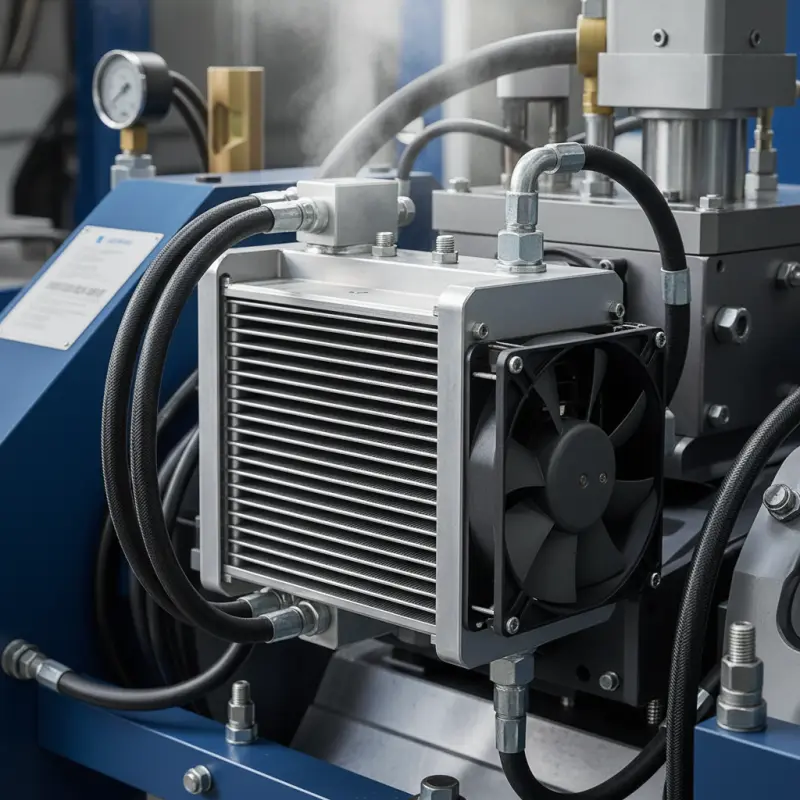
A hydraulic oil cooler is a heat exchanger designed to remove excess heat from hydraulic oil. It transfers heat from the hot hydraulic fluid to another cooling medium, usually air or water.
During normal operation, a hydraulic system converts mechanical energy into hydraulic energy. However, not all energy is transferred efficiently. Some energy is lost as heat due to:
- Fluid friction
- Internal leakage
- Pressure losses
- Pump inefficiency
- Valve throttling
- High-pressure operation
- Continuous machine operation
- High ambient temperatures
As the hydraulic oil temperature increases, the properties of the fluid can change. Excessive heat may reduce the oil’s viscosity and lubrication performance. It can also affect seals, hoses, pumps, valves, and other critical components.
A properly sized hydraulic oil cooler helps control this temperature and keeps the system operating efficiently.
Why Is Hydraulic Oil Cooling Important?
Temperature control is essential for maintaining hydraulic system performance. When hydraulic oil becomes too hot, several problems may occur.
Reduced Oil Viscosity
Hydraulic oil needs the correct viscosity to lubricate components and transfer power effectively. Excessive heat can make the oil thinner, reducing its ability to provide proper lubrication.
Increased Component Wear
Hot hydraulic oil may reduce the protective oil film between moving parts. This can increase friction and accelerate wear on pumps, motors, valves, and cylinders.
Damage to Seals and Hoses
High temperatures can cause seals, gaskets, and hoses to harden, crack, or deteriorate more quickly.
Faster Oil Degradation
Excessive heat accelerates the oxidation and degradation of hydraulic oil. This may result in sludge formation, deposits, and reduced fluid life.
Reduced System Efficiency
When the hydraulic system operates outside its recommended temperature range, efficiency may decrease and machine performance can become less consistent.
For these reasons, installing the correct hydraulic oil cooler can help improve equipment reliability and reduce long-term maintenance costs.
Hydraulic Oil Cooler Working Principle
The working principle of a hydraulic oil cooler is based on heat transfer.
The process is relatively simple:
- Hot hydraulic oil enters the cooler.
- The oil flows through internal passages or tubes.
- Heat transfers from the hot oil to the cooler material.
- The heat is transferred to air or water.
- The cooled hydraulic oil leaves the cooler.
- The cooler oil returns to the hydraulic system.
The cooling medium depends on the type of oil cooler being used.
For example, an air-cooled hydraulic oil cooler uses a fan to move air across the heat exchanger. The air absorbs heat from the oil cooler and carries it away.
A water-cooled hydraulic oil cooler uses water to absorb heat from the hydraulic oil. The heated water is then circulated away or cooled through another system.
The amount of heat removed depends on several factors, including:
- Hydraulic oil flow rate
- Oil inlet temperature
- Cooling medium temperature
- Cooler design
- Surface area
- Airflow or water flow
- Oil viscosity
Types of Hydraulic Oil Coolers
There are several types of hydraulic oil coolers available for different industrial applications.
1. Air-Cooled Hydraulic Oil Cooler
An air-cooled hydraulic oil cooler uses ambient air as the cooling medium. A fan forces or pulls air through the cooling core.
These coolers are commonly used where a reliable water supply is not available.
Advantages
- No water supply required
- Simple installation
- Suitable for mobile equipment
- Lower risk of water contamination
- Easy to operate
Common Applications
- Construction machinery
- Agricultural equipment
- Mobile hydraulic systems
- Mining equipment
- Industrial machines
However, air-cooled units may become less effective when ambient temperatures are very high or when cooling fins become blocked by dust and debris.
2. Water-Cooled Hydraulic Oil Cooler
A water-cooled hydraulic oil cooler uses water as the cooling medium.
The hydraulic oil and water remain separated inside the heat exchanger while heat transfers from the hot oil to the cooler water.
Advantages
- High cooling efficiency
- Suitable for high heat loads
- Compact design
- Less dependent on ambient air temperature
Common Applications
- Industrial plants
- Marine applications
- Large manufacturing systems
- Power generation equipment
Water quality should be considered carefully because scale, corrosion, and contamination can reduce cooling efficiency.
3. Shell-and-Tube Oil Cooler
A shell-and-tube cooler typically contains a bundle of tubes inside an outer shell. One fluid flows through the tubes while the other flows around them.
These coolers are commonly used in industrial systems that require reliable and continuous cooling.
Benefits
- Durable construction
- Suitable for high-pressure applications
- Can handle significant heat loads
- Easy to service in some designs
4. Plate Heat Exchanger
A plate heat exchanger contains multiple thin metal plates that create separate flow channels for the two fluids.
The large heat-transfer surface allows efficient cooling in a compact space.
Advantages
- Compact size
- High heat-transfer efficiency
- Suitable for limited installation space
These are often used where space efficiency is important.
How to Select the Right Hydraulic Oil Cooler
Selecting a hydraulic oil cooler should not be based only on the physical size of the equipment. Several technical factors must be considered to ensure effective cooling.
1. Calculate the Heat Load
The first and most important step is determining how much heat must be removed from the hydraulic system.
Heat load is often expressed in kilowatts.
A system that generates more heat requires a higher-capacity oil cooler. If the cooler is undersized, the oil temperature may remain too high even when the cooler is operating correctly.
2. Check Hydraulic Oil Flow Rate
The oil cooler must be capable of handling the required flow rate.
If the flow rate is too high for the selected cooler, the system may experience excessive pressure drop. This can reduce efficiency and place additional load on the hydraulic pump.
Always check the manufacturer’s recommended oil flow range.
3. Consider Operating Pressure
The cooler must be rated for the maximum pressure of the hydraulic circuit where it will be installed.
This is particularly important when the cooler is installed in a high-pressure line.
The following should be verified:
- Maximum working pressure
- Pressure spikes
- Connection ratings
- Hose ratings
- Fitting compatibility
4. Consider Oil Type and Viscosity
Different hydraulic fluids have different viscosity characteristics.
Cold oil is usually thicker and may create a higher pressure drop through the cooler. The cooler should therefore be selected based on the expected oil viscosity and operating temperature.
5. Consider Ambient Temperature
For air-cooled oil coolers, the surrounding air temperature has a major effect on performance.
If the machine operates in a hot environment, the cooler must be designed to perform effectively under those conditions.
A cooler that works well in a moderate climate may not provide enough cooling capacity in a high-temperature industrial environment.
6. Determine the Required Oil Temperature
Consider:
- Maximum allowable oil temperature
- Normal operating temperature
- Oil inlet temperature
- Required outlet temperature
- Cooling medium temperature
The temperature difference between the oil and the cooling medium directly affects the amount of heat that can be transferred.
7. Check Available Installation Space
Measure the available installation area before selecting the cooler.
Consider:
- Overall dimensions
- Hose connection locations
- Fan clearance
- Airflow path
- Maintenance access
A compact cooler may be necessary where installation space is limited.
Hydraulic Oil Cooler Installation Guidelines
Proper installation is essential for achieving the expected cooling performance.
Installation of Air-Cooled Oil Coolers
When installing an air-cooled hydraulic oil cooler, place it in a location with sufficient airflow.
Important installation practices include:
- Allow adequate clearance around the cooler.
- Avoid placing the unit where hot air can recirculate.
- Keep the cooling surface away from major dust sources when possible.
- Ensure correct fan rotation.
- Check the direction of airflow.
- Install protective guards where necessary.
- Mount the cooler securely to reduce vibration damage.
The cooler should receive clean, cool air. If hot exhaust air is drawn back into the cooler, its performance may decrease significantly.
Installation of Water-Cooled Oil Coolers
For water-cooled systems, ensure that the water supply provides sufficient flow.
Important factors include:
- Water inlet temperature
- Water flow rate
- Water pressure
- Water quality
- Corrosion risk
- Scale formation
Water filters or treatment systems may be necessary depending on the water quality.
Use Proper Hose and Pipe Connections
All hoses and fittings should be correctly sized.
Avoid:
- Excessive bends
- Kinked hoses
- Unnecessary restrictions
- Poorly supported piping
Improper connections can increase pressure drop and reduce cooling efficiency.
Install a Bypass When Required
In some hydraulic systems, a thermostat or bypass valve may be used to control oil flow through the cooler.
This can help:
- Prevent excessive pressure drop during cold starts
- Improve warm-up performance
- Protect the cooler
- Maintain more stable oil temperatures
The correct bypass arrangement depends on the hydraulic system design.
Hydraulic Oil Cooler Maintenance
Regular maintenance is essential for maintaining cooling efficiency.
A dirty or damaged cooler may not remove enough heat, even if it was correctly sized.
1. Clean Air-Cooled Fins
Dust, dirt, oil, leaves, and other debris can block airflow through the cooling fins.
Regularly inspect the cooler and clean the fins carefully.
Avoid using sharp objects that could damage the fins.
Depending on the equipment and environment, cleaning may be performed using:
- Low-pressure compressed air
- Soft brushes
- Appropriate cleaning methods recommended by the manufacturer
Keeping the fins clean improves airflow and heat transfer.
2. Inspect for Oil Leaks
Check the following regularly:
- Hose connections
- Fittings
- Seals
- Cooler body
- Welded areas
Oil leaks should be repaired immediately.
A small leak can become a larger maintenance problem and may also create safety concerns.
3. Check Fan Operation
For air-cooled systems, inspect:
- Fan motor
- Electrical connections
- Fan rotation
- Fan blades
- Mounting hardware
A failed or incorrectly rotating fan can significantly reduce cooling performance.
4. Monitor Oil Temperature
Regular temperature monitoring helps identify cooling problems before major component damage occurs.
If oil temperature begins increasing above the normal operating range, inspect:
- Cooler cleanliness
- Fan operation
- Water flow
- Oil flow
- System load
- Cooler capacity
5. Inspect Water Passages
Water-cooled systems can develop scale or deposits over time.
These deposits reduce heat transfer and restrict water flow.
Regular cleaning may be necessary depending on:
- Water quality
- Operating hours
- Cooling system design
6. Monitor Pressure Drop
A high pressure drop across the cooler may indicate:
- Internal blockage
- Incorrect cooler size
- Excessive oil viscosity
- Restricted hoses
- Contamination
Pressure-drop monitoring can help identify problems early.
Common Hydraulic Oil Cooler Problems and Solutions
Problem: Hydraulic Oil Temperature Is Too High
Possible causes:
- Cooler is undersized
- Cooling fins are dirty
- Fan is not operating
- Ambient temperature is too high
- Water flow is insufficient
- Heat load has increased
Possible solutions:
- Clean the cooler
- Inspect the fan
- Check airflow
- Increase cooling capacity
- Inspect the hydraulic system for excessive heat generation
Problem: High Pressure Drop
Possible causes:
- Cooler passages are blocked
- Oil viscosity is too high
- Flow rate is excessive
- Incorrect cooler size
- Restricted hoses
Solution:
Inspect the entire oil flow path and clean or replace the affected components if necessary.
Problem: Oil Leakage
Possible causes:
- Loose fittings
- Damaged seals
- Cracked connections
- Excessive vibration
- Pressure exceeding the cooler rating
Solution:
Inspect the system carefully and repair or replace damaged components.
Problem: Poor Cooling Performance
Possible causes:
- Dirty cooling surface
- Low airflow
- Low water flow
- High ambient temperature
- Internal fouling
- Incorrect cooler size
A complete inspection should be performed instead of replacing the cooler immediately.
Best Practices for Improving Hydraulic Cooling Performance
To maximize the performance of a hydraulic oil cooler:
- Select the correct cooler capacity.
- Keep cooling surfaces clean.
- Monitor oil temperature regularly.
- Maintain proper hydraulic fluid levels.
- Use the correct hydraulic oil.
- Inspect filters regularly.
- Prevent excessive pressure losses.
- Maintain adequate airflow or water flow.
- Repair leaks quickly.
- Avoid operating the system beyond its design limits.
It is also important to remember that a hydraulic oil cooler can remove heat, but it may not solve the underlying cause of excessive heat generation.
For example, a damaged pump, excessive internal leakage, incorrect valve settings, or system inefficiency may cause the hydraulic system to generate more heat than normal.
In these situations, simply installing a larger oil cooler may not completely solve the problem. The source of the excessive heat should also be identified and corrected.
Frequently Asked Questions About Hydraulic Oil Coolers
1. What is the main purpose of a hydraulic oil cooler?
The main purpose of a hydraulic oil cooler is to remove excess heat from hydraulic fluid and maintain the system within a suitable operating temperature range.
2. How do I know if my hydraulic system needs an oil cooler?
A hydraulic system may need additional cooling if the oil temperature regularly becomes too high, components overheat, oil degrades quickly, or machine performance decreases during continuous operation.
3. Which is better: an air-cooled or water-cooled hydraulic oil cooler?
The best choice depends on the application. Air-cooled units are easier to install and do not require water, while water-cooled units can provide high cooling capacity in industrial applications.
4. Can a hydraulic oil cooler be too large?
An oversized cooler may increase cost and installation requirements. In some systems, excessively cold oil can also increase viscosity. A properly sized cooler with suitable temperature control is generally the best solution.
5. How often should a hydraulic oil cooler be cleaned?
Cleaning frequency depends on the operating environment. Equipment used in dusty or dirty conditions may require more frequent inspection and cleaning.
6. What causes hydraulic oil to overheat?
Common causes include excessive pressure losses, inefficient pumps, internal leakage, undersized coolers, blocked cooling surfaces, poor airflow, and high ambient temperatures.
7. Can a blocked oil cooler damage the hydraulic system?
Yes. A blocked or restricted oil cooler can reduce oil flow, increase pressure drop, and prevent effective heat removal. This may contribute to overheating and reduced system performance.
Conclusion
A hydraulic oil cooler is an important component in systems where excess heat can affect performance, reliability, and component life. By transferring heat away from the hydraulic fluid, the cooler helps maintain proper oil temperature and supports efficient system operation.
The correct hydraulic oil cooler should be selected based on factors such as heat load, oil flow rate, operating pressure, oil viscosity, ambient temperature, cooling medium, and available installation space.
Proper installation is equally important. Air-cooled systems require adequate airflow and regular cleaning, while water-cooled systems require reliable water flow and attention to water quality.
Regular maintenance, including cleaning, leak inspection, temperature monitoring, fan checks, and pressure-drop monitoring, can help ensure long-term cooling performance.
Ultimately, a properly selected, installed, and maintained hydraulic oil cooler can reduce overheating, extend hydraulic fluid life, protect expensive components, improve equipment reliability, and lower overall maintenance costs.
